
Ontario County Wanted Fugitives
Ontario County points the public toward its app for fugitive information. The county flyer highlights a Most Wanted feature, and an earlier mobile-app specification lists outstanding warrants among the functions it asked for. So the official channel is the Ontario Sheriff NY App. A browser-based list is a different matter. The county publishes no searchable wanted roster online, no count of listed persons, no posting schedule, and no standard fields for each notice.
That gap leaves room for bad assumptions. An old screenshot, an unofficial directory, or a name that seems missing proves nothing either way about an active warrant. When you need current notice information, go to the live official feature. Anything still unclear should go through the court or the Sheriff. The county's official public-reporting channel for tips tied to the app materials is the Ontario County Sheriff report route.
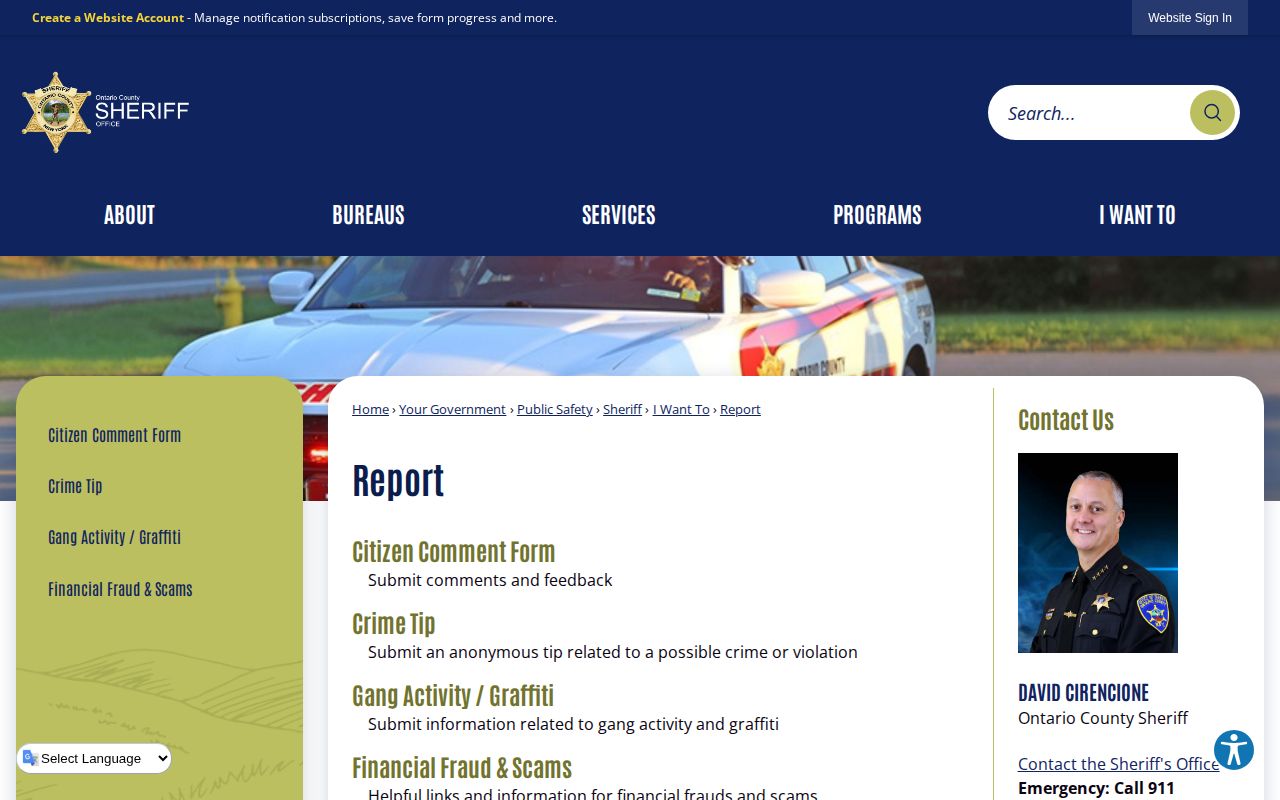
The report screen gets information to the Sheriff. That is its whole job. It is not a warrant database, and it is not a public roster of current names.
Ontario County Warrant Notice Fields
An official notice usually carries enough detail for a useful tip. Ontario County has not published a fixed format for its wanted notices, though, so treat each field below as a possibility rather than a promise that the app will show it. Notices can change or come down as circumstances shift. Two cautions apply. Never copy a name or image into a personal post, and never identify someone from a partial match.
| Possible field | What it may identify |
|---|---|
| Name | The identity used in the official notice, which still needs careful confirmation. |
| Photograph | An image when the official notice supplies one; universal app photo display is not verified. |
| Warrant or incident type | Limited context for the notice. |
| Issuing agency or court | The office that can help direct a records or warrant question. |
| Date and tip contact | When shown, a date and the official channel for passing information to law enforcement. |
Read the wording as a notice. It is not a criminal history. Charges can be amended, dismissed, or resolved later. The originating court and agency hold the record that counts.
Use Ontario County Wanted App
The app is the County's documented bridge between public alerts, inmate information, most wanted notices, and tip tools. An uses the public labels
and
The procurement paperwork goes further, naming
and
That gap is worth noticing. A feature named in a spec does not guarantee every live field, a current photo, or old results. Look at what the app actually displays on the day you search.
- Open the official Sheriff app from the County landing page and look for the current Most Wanted or public-reporting feature.
- Read the complete notice, including any issuing agency and contact instruction, before drawing conclusions from a name or image.
- Use the stated official tip channel if you have relevant information. Do not contact, follow, or try to locate the person yourself.
- For a custody question after a reported arrest, use the Ontario County locator and booking-record routes and note the date checked.
Note the source date whenever you check a notice. Features change, and a notice that vanishes may reflect resolution, a new communication choice, or something the public simply cannot see. Only the issuing court or an authorized law-enforcement office can confirm the status of a particular warrant. Treat the app as a public-safety channel. It is not a court record, and it is not legal advice.
Ontario County Warrant Tip Routes
The County's promotes the Sheriff app and public reporting, and the County also points to a non-emergency tip route through its public resources. What you will not find confirmed is a separate Ontario County reward program, a private Crime Stoppers organization, or a promise of anonymity. Assume none of those apply unless the live official channel says so. When you call dispatch, stick to firsthand facts you can describe clearly. A location, a time, a vehicle detail, or a direction of travel all help.
Call 911 for an emergency or immediate danger. For anything less urgent, use the official report route or the Sheriff's non-emergency number. Never approach, confront, follow, photograph, transport, or detain someone because of a wanted notice. That job belongs to trained officers.
The official route is deliberately narrower than a private reward board or a casual social post. The app, the report page, and Sheriff public-safety communications are all verified; a separate Crime Stoppers organization, a reward amount, and guaranteed anonymity are not. Leave those claims out of your report. Give the agency only what you directly observed, keep the date and location, and let trained personnel decide what happens next.
Ontario County Warrant Checks
Ontario County has no guaranteed public warrant search by name. The county's Quick Links page gathers public-safety resources, and the Sheriff's app was built to carry outstanding-warrant information. Neither is a free live database of warrants. Keep expectations realistic. A jail locator shows who is in custody now, which is a different question from who has a warrant. A blank search result or a stale third-party page proves nothing at all.
If a warrant might name you, take the resolve-first path. Find the likely issuing court. Talk to an attorney, then call the Sheriff's non-emergency line so your question gets routed correctly. The Ontario County Clerk keeps the official civil and criminal court records, though its public page stops short of promising a free real-time warrant lookup. Court staff can walk you through a court process. They cannot give legal advice, so bring detailed questions to a lawyer instead.
- Gather the exact name, date of birth, case number, or court information already known. Avoid relying on a nickname or a third-party summary.
- Contact the issuing court or an attorney to determine the proper court-level process and whether counsel should handle the matter.
- Call the Sheriff’s non-emergency number for official routing when a law-enforcement contact is appropriate.
- Follow the court or attorney’s lawful resolution instructions. Do not attempt to test a warrant in person or avoid official contact.
Important: A warrant is a court or law-enforcement process, and its validity, scope, and current status must be confirmed through the issuing authority.
Ontario County Arrest and Bench Warrants
Warrant labels sound alike but mark different starting points. The definitions here are general legal terms, not a tally of Ontario County warrants. Whatever document a court actually issued controls the matter. For a term that appears in a real case, a court or an attorney is the right place to get it explained.
| Term | General meaning |
|---|---|
| Arrest warrant | A court-issued warrant authorizing an arrest based on a sworn charge or other legal showing. |
| Bench warrant | A warrant issued by a court, often after a required appearance is missed or a court direction is not followed. |
A warrant's label tells you how a case started. It does not say where the person is held. It does not say how the case ends. A later proceeding can amend the charge, resolve the warrant, or reach a different outcome.
Custody status is a separate question. Someone named in a court process might sit in county custody, state custody, another jurisdiction, or nowhere at all. That is why the locator, the app, and a warrant check are three different tools. Use the locator for qualifying custody, the app for current public notices, and the issuing court or an attorney for anything case-specific.
Ontario County Warrant Program Context
The 2024 Ontario County annual report gives useful context on the Sheriff's Warrant Division. It counted 1,248 matters processed that report year. The breakdown includes 631 new warrants, 598 executed or closed matters, 109 same-day matters, and 368 open ones. Those are annual program totals. They identify no one, and they are not a current wanted list, so they cannot tell you who might be wanted today.
Program reports and wanted notices do different jobs. A yearly workload table records how a division handled matters across a reporting period. A wanted notice is an operational message that can shift with a court action, an arrest, a correction, or a public-safety call. Neither can replace confirmation from the issuing authority. That line matters. It stops a dated statistic from being read as a person search.
The dated figures show a busy warrant function, not a live inventory. The 2023 report posts different executed-or-closed and open numbers. That is one more reason to confirm any current matter with the issuing court or the Sheriff rather than leaning on a yearly statistic.
The county's own materials also draw a line between app features and a public name search. The mobile-app flyer advertises Most Wanted, inmate information, news, alerts, and tips. The earlier spec names outstanding warrants, inmate search, and recent arrests among requested functions. Neither document offers a permanent browser list, a posting schedule, an official count of notices, or a fixed layout. Use the live app and the Sheriff report route for official communications. Take a personal warrant question to the issuing authority.
Time complicates things further. A court can issue, amend, or recall a warrant as a case develops, and no annual report tracks those moves. A locator can show qualifying incarceration without confirming every warrant, while a missing app notice does not erase a court process. The trail that matters runs through the issuing court, the correct case information, and lawful Sheriff routing. That keeps each piece in its proper place.
Public Record Search
Sponsored Results